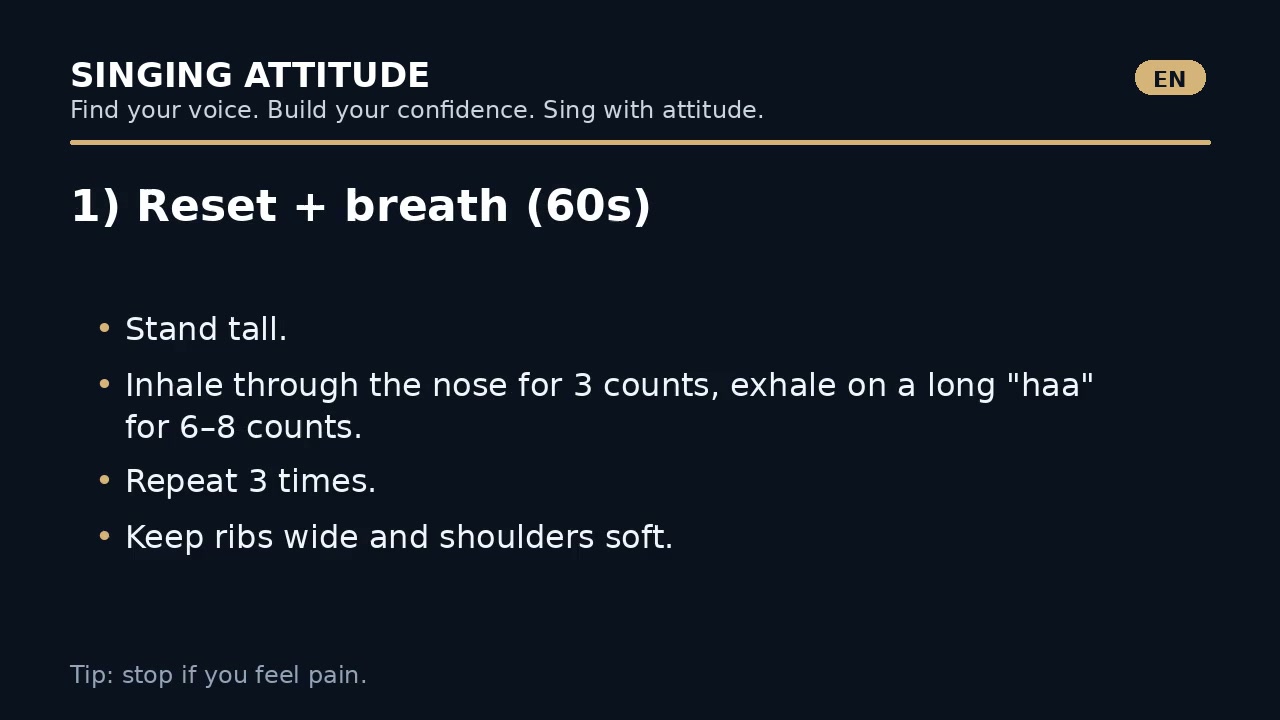
Warmups PDF (RU)
A short written guide for adults who want a repeatable vocal ritual before singing.
Download the PDFFREE LIVE ONLINE WEBINAR
Sunday 19 July6:00pm BST / British Summer TimeOnline with Liuba DogaTimezone: Europe/London
Starts in
Limited live places available.
Free warmup guide
Warmups can help prepare the voice. But if the same crack, tightness, breath pressure, or confidence issue keeps returning, the real blocker may need to be identified.

Warmup ritual
Prepare the voice without forcing.
Adult voice
Focused
Designed for adult singers online.
Gentle prep
No forcing
Warm up without pushing for volume.
Diagnostic
Notice patterns
Use warmups to learn what returns.
Clear next step
Quiz or Evaluation
Choose support when the blocker stays.
Start here
Singing warmups are designed to help your voice prepare for singing by easing coordination, breath, resonance, and attention. They should not feel like forcing the voice into shape.
Reviewed by Liuba Doga, founder of Singing Attitude and professional vocal coach · Updated
Quick answer
If a warmup keeps making the voice tighter, the warmup may not be the real issue. A recurring crack, tight throat, unstable high note, or changing vowel can point to the blocker underneath.
Use warmups as feedback
The routine is most useful when it gives you a calm first sound and a clearer read on what happens next. If the same issue returns, that is a clue, not a reason to push harder.
In short
Use warmups before practice, rehearsal, recording, or a lesson. Keep the routine short, gentle, and consistent.
Warmup library
Download the PDF and follow the walkthrough to anchor your daily vocal ritual. Choose the language you need; the asset links stay matched to the selected language.
A short written guide for adults who want a repeatable vocal ritual before singing.
Download the PDFVideo
Follow the walkthrough so the routine stays calm, light, and practical instead of becoming another pressure test.
Watch the walkthroughWalkthrough
Watch the existing warmup walkthrough for the selected language. Keep the sound easy, stop before fatigue, and use what you notice as information.
Selected walkthrough
RUWhile you watch
Keep the sound easy and notice what repeats before adding more effort.
Practical choice
Different warmups suit different needs. Start with the smallest useful sound, then only add range, volume, or complexity if the voice stays easy.
Use this as a map
Choose the gentlest useful route first. If the same pattern returns after warming up, treat it as a clue for the quiz or Evaluation rather than adding more force.
Choose this when
Choose gentle release or coordination work. Keep the sound easy enough that you can notice whether the throat softens or grips.
Choose this when
Start lighter before adding volume. A warmup should prepare the coordination, not pressure the voice into a bigger sound.
Choose this when
Use warmups that calm pressure and timing. More air is not always the useful answer when the voice is already bracing.
Choose this when
Choose transition work and smaller sounds first. Repeating the same louder pattern can hide the real coordination issue.
Choose this when
Begin with simple, low-pressure sounds. The goal is to feel present enough to listen, not to prove the voice immediately.
Diagnosis-first
Warmups prepare the voice. They do not always identify why the same issue returns. If the pattern stays, choose a route that gives you more clarity before adding more exercises.
The repeated point matters more than the exercise list.
The warmup may be revealing pressure, not solving it.
More effort can hide the coordination that needs attention.
Nerves, vowels, and intention can expose the real blocker.
Clearer routes
The Voice Blocker Quiz helps identify likely patterns. The Singing Evaluation lets Liuba hear what is actually happening.
Choose the next step
Use warmups for preparation, then move to the route that matches the real decision in front of you.
Prepare the voice before practice, rehearsal, recording, or a lesson.
Understand the likely pattern when the same issue keeps returning.
Get personal clarity when you want Liuba to hear what is actually happening.
Use a short clip when there is a specific visible or audible issue to review.
Move into ongoing support after the first useful next step is clearer.
Watch related videos
Watch the warmups walkthrough as a dedicated page, then use the full video library if you want more diagnosis-first context.
Related resources
Keep this page focused on warmups, then use the full hubs when you need a deeper comparison or written guide.
Warmup questions
For most adult singers, a short and gentle routine is enough to begin. Stop before the voice feels tired and use the warmup to notice what changes, rather than forcing a fixed amount of time.
No. Warmups should help the voice prepare, not leave it strained. If a warmup repeatedly makes the voice tighter, cracks more, or feels tiring, simplify it and look at the blocker underneath.
Warmups can help you notice and prepare transitions, but recurring cracks often need clearer diagnosis. The Voice Blocker Quiz or a Singing Evaluation can help you understand the likely pattern.
Reduce volume, range, and effort, then return to an easier sound. If tightness keeps returning, the warmup may be revealing a pattern that needs personal feedback.
Yes. They are intended as a gentle, repeatable starting ritual for adult singers. Stay comfortable, keep the sounds light, and avoid turning the routine into a test.
If the same crack, tightness, breath pressure, unstable high note, or confidence issue returns every time, Evaluation is the clearer route because Liuba can listen to what is actually happening.
Warmups are a start
Start with the free Voice Blocker Quiz, or book a Singing Evaluation if you want Liuba to hear what is really happening.
Start the free Voice Blocker QuizBest next use
Use warmups
Before singing, keep the voice gentle and attentive.
Notice patterns
Track what keeps returning instead of pushing harder.
Choose diagnosis
Use the quiz or Evaluation when the pattern needs clarity.