Notice the symptom
Why random singing exercises often miss the real cause.
Singing Attitude videos
This video explains the diagnosis-first approach behind Singing Attitude: listen to the voice, identify the real blocker, then choose the next step with care.
Teaching focus
Diagnostic
Understand the pattern first
Audience
Adults 18+
Built for real adult voices
Next step
Clear route
Choose proportionate support
Format
Online-only
For singers worldwide
Quick answer
This video explains the diagnosis-first approach behind Singing Attitude: listen to the voice, identify the real blocker, then choose the next step with care.
Answer summary
In this video, Liuba explains what a singing evaluation is and when it is the right next step.
A singing evaluation is a personalised diagnostic review of your voice. You send a short recording, Liuba Doga identifies the vocal habits holding you back, and you receive a clear practice plan for what to work on next.
Key idea
The teaching point stays close to the video itself: look for the real vocal pattern before choosing exercises, lessons, or a bigger commitment.
Why random singing exercises often miss the real cause.
How an Online Voice Evaluation helps separate symptoms from root patterns.
Why technique, attitude, and expression need to be considered together.
Watch notes
A readable text version is kept on the page for search intent, accessibility, and quick review after watching.
In this video
Watch Liuba explain why Singing Attitude starts with vocal diagnosis before choosing exercises, lessons, or longer-term coaching.
53 seconds
Many singers arrive with a symptom: a crack, a tight note, a breath problem, or a voice that changes every day.
The Singing Attitude approach does not start by guessing which exercise might help. It starts by listening to what the voice is doing and identifying which part of the system is leading the problem.
Once the cause is clearer, the next step can be proportionate: an Online Voice Evaluation, focused 1:1 coaching, or a simpler practice route.
Recommended next step
Use the Evaluation when you want a clear diagnosis before committing to ongoing support.
If you are unsure what is blocking your voice, start with the Voice Blocker Quiz or the Online Voice Evaluation.
If you already have a clear clip showing the issue, Video Feedback may be the simpler route.
Diagnosis route
If the video sounds familiar, keep the route diagnosis-first instead of collecting more random exercises.
Related pages
These links are the existing page-specific next routes for this video.
See how Singing Attitude names the repeatable patterns that can sit behind cracks, tightness, breath issues, and inconsistency.
Return to the main Singing Attitude starting point.
See the diagnosis-first entry product.
Explore live 1:1 online coaching.
Watch related videos
Watch short Singing Attitude videos that explain the diagnosis-first approach, evaluation, courses, and warmup practice.
 1 minute 27 secondsYour Voice Is Not BrokenThis video supports singers who worry their voice is beyond help. Most cracks, strain, range changes, and unreliable notes have causes that can be observed and worked with.
 1 minuteWhat Is a Singing Evaluation?Liuba explains the purpose of the Online Voice Evaluation and why it starts with understanding your voice before recommending the next step.
 1 minute 7 secondsWhy Start With Evaluation?Liuba explains why the Evaluation protects your next investment by clarifying what your voice needs before ongoing lessons.
 22 secondsMeet Liuba: Course IntroductionThis short introduction gives context for the Singing Attitude course pathway and the care behind the upcoming online course library.
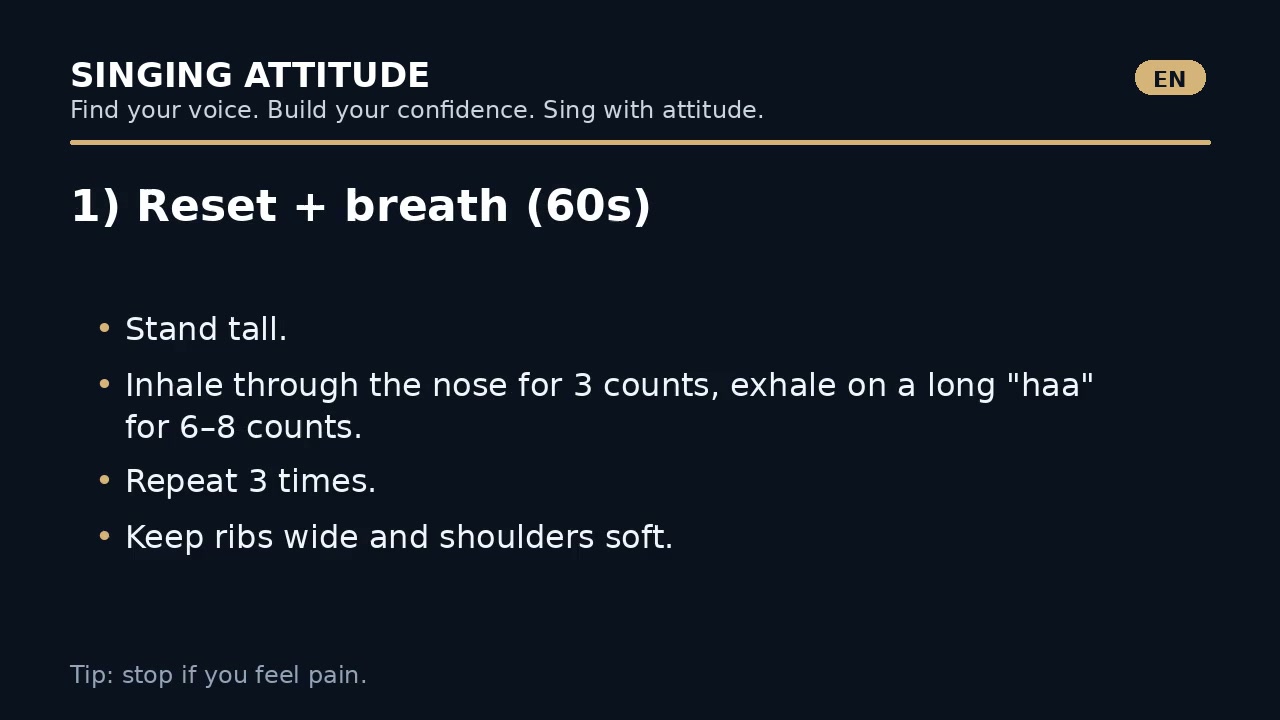 2 minutes 1 second5-Minute Warmup RitualThis short ritual helps you prepare the voice with ease, consistency, and attention rather than pressure.

After watching
The video gives you the principle. The next useful step is getting the real pattern in your own voice identified calmly and clearly.
Use the Evaluation when the blocker is still unclear.
Use feedback when a short clip already shows what needs correction.
Still choosing?
Use the quiz if you recognise the problem but still cannot tell whether Evaluation, feedback, coaching, or Lab is the right next step.


 1K+
1K+